A Film Review by James Berardinelli
United States, 1997
U.S. Release Date: 12/19/97 (wide)
Running Length: 3:14
MPAA Classification: PG-13 (Mayhem, nudity, sex, profanity, mild violence)
Theatrical Aspect Ratio: 2.35:1
Cast: Leonardo DiCaprio, Kate Winslet, Billy Zane, Kathy Bates, Frances Fisher, Gloria Stuart, Bill Paxton, Bernard Hill, David Warner
Director: James Cameron
Producers: James Cameron, Jon Landau
Screenplay: James Cameron
Cinematography: Russell Carpenter
Music: James Horner
U.S. Distributor: Paramount Pictures
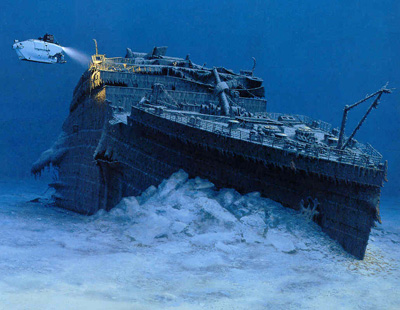
Short of climbing aboard a time capsule and peeling back eight and one-half decades, James Cameron's magnificent Titanic is the closest any of us will get to walking the decks of the doomed ocean liner. Meticulous in detail, yet vast in scope and intent, Titanic is the kind of epic motion picture event that has become a rarity. You don't just watch Titanic, you experience it -- from the launch to the sinking, then on a journey two and one-half miles below the surface, into the cold, watery grave where Cameron has shot never-before seen documentary footage specifically for this movie.
In each of his previous outings, Cameron has pushed the special effects envelope. In Aliens, he cloned H.R. Giger's creation dozens of times, fashioning an army of nightmarish monsters. In The Abyss, he took us deep under the sea to greet a band of benevolent space travelers. In T2, he introduced the morphing terminator (perfecting an effects process that was pioneered in The Abyss). And in True Lies, he used digital technology to choreograph an in-air battle. Now, in Titanic, Cameron's flawless re-creation of the legendary ship has blurred the line between reality and illusion to such a degree that we can't be sure what's real and what isn't. To make this movie, it's as if Cameron built an all-new Titanic, let it sail, then sunk it.
Of course, special effects alone don't make for a successful film, and Titanic would have been nothing more than an expensive piece of eye candy without a gripping story featuring interesting characters. In his previous outings, Cameron has always placed people above the technological marvels that surround them. Unlike film makers such as Roland Emmerich and Dean Devlin, Cameron has used visual effects to serve his plot, not the other way around. That hasn't changed with Titanic. The picture's spectacle is the ship's sinking, but its core is the affair between a pair of mismatched, star-crossed lovers.
Titanic is a romance, an adventure, and a thriller all rolled into one. It contains moments of exuberance, humor, pathos, and tragedy. In their own way, the characters are all larger-than- life, but they're human enough (with all of the attendant frailties) to capture our sympathy. Perhaps the most amazing thing about Titanic is that, even though Cameron carefully recreates the death of the ship in all of its terrible grandeur, the event never eclipses the protagonists. To the end, we never cease caring about Rose (Kate Winslet) and Jack (Leonardo DiCaprio).

Titanic sank during the early morning hours of April 15, 1912 in the North Atlantic, killing 1500 of the 2200 on board. The movie does not begin in 1912, however -- instead, it opens in modern times, with a salvage expedition intent on recovering some of the ship's long-buried treasure. The expedition is led by Brock Lovett (Bill Paxton), a fortune hunter who is searching for the mythical "Heart of the Ocean", a majestic 56 karat diamond which reputedly went down with the ship. After seeing a TV report about the salvage mission, a 101-year old woman (Gloria Stuart) contacts Brock with information regarding the jewel. She identifies herself as Rose DeWitt Bukater, a survivor of the tragedy. Brock has her flown out to his ship. Once there, she tells him her version of the story of Titanic's ill-fated voyage.
The bulk of the film -- well over 80% of its running time -- is spent in flashbacks. We pick up the story on the day that Titanic leaves Southampton, with jubilant crowds cheering as it glides away from land. On board are the movie's three main characters: Rose, a young American debutante trapped in a loveless engagement because her mother is facing financial ruin; Cal Hockley (Billy Zane), her rich-but-cold-hearted fiancé; and Jack Dawson, a penniless artist who won his third-class ticket in a poker game. When Jack first sees Rose, it's from afar, but circumstances offer him the opportunity to become much closer to her. As the voyage continues, Jack and Rose grow more intimate, and she tries to summon up the courage to defy her mother (Frances Fisher) and break off her engagement. But, even with the aid of an outspoken rich women named Molly Brown (Kathy Bates), the barrier of class looms as a seemingly-insurmountable obstacle. Then, when circumstances in the Rose/Cal/Jack triangle are coming to a head, Titanic strikes an iceberg and the "unsinkable" ship (that term is a testament to man's hubris) begins to go down.
By keeping the focus firmly on Rose and Jack, Cameron avoids one frequent failing of epic disaster movies: too many characters in too many stories. When a film tries to chronicle the lives and struggles of a dozen or more individuals, it reduces them all to cardboard cut-outs. In Titanic, Rose and Jack are at the fore from beginning to end, and the supporting characters are just that -- supporting. The two protagonists (as well as Cal) are accorded enough screen time for Cameron to develop multifaceted personalities.
As important as the characters are, however, it's impossible to deny the power of the visual effects. Especially during the final hour, as Titanic undergoes its death throes, the film functions not only as a rousing adventure with harrowing escapes, but as a testimony to the power of computers to simulate reality in the modern motion picture. The scenes of Titanic going under are some of the most awe-inspiring in any recent film. This is the kind of movie that it's necessary to see more than once just to appreciate the level of detail.
One of the most unique aspects of Titanic is its use of genuine documentary images to set the stage for the flashback story. Not satisfied with the reels of currently-existing footage of the sunken ship, Cameron took a crew to the site of the wreck to do his own filming. As a result, some of the underwater shots in the framing sequences are of the actual liner lying on the ocean floor. Their importance and impact should not be underestimated, since they further heighten the production's sense of verisimilitude.
For the leading romantic roles of Jack and Rose, Cameron has chosen two of today's finest young actors. Leonardo DiCaprio (Romeo + Juliet), who has rarely done better work, has shed his cocky image. Instead, he's likable and energetic in this part -- two characteristics vital to establishing Jack as a hero. Meanwhile, Kate Winslet, whose impressive resume includes Sense and Sensibility, Hamlet, and Jude, dons a flawless American accent along with her 1912 garb, and essays an appealing, vulnerable Rose. Billy Zane comes across as the perfect villain -- callous, arrogant, yet displaying true affection for his prized fiancé. The supporting cast, which includes Kathy Bates, Bill Paxton, Frances Fisher, Bernard Hill (as Titanic's captain), and David Warner (as Cal's no-nonsense manservant), is flawless.
While Titanic is easily the most subdued and dramatic of Cameron's films, fans of more frantic pictures like Aliens and The Abyss will not be disappointed. Titanic has all of the thrills and intensity that movie-goers have come to expect from the director. A dazzling mix of style and substance, of the sublime and the spectacular, Titanic represents Cameron's most accomplished work to date. It's important not to let the running time hold you back -- these three-plus hour pass very quickly. Although this telling of the Titanic story is far from the first, it is the most memorable, and is deserving of Oscar nominations not only in the technical categories, but in the more substantive ones of Best Picture, Best Director, Best Actor, and Best Actress.
WRITTEN BY SHUBHENDU TRIPATHI (MR.36)

Shoes found during the rescue and recovery of the Titanic, Maritime Museum of the Atlantic
Cape Breton Island, Nova Scotia 1998
%E0%A4%AB%E0%A5%8B%E0%A4%9F%E0%A5%8B013.jpg)
%E0%A4%AB%E0%A5%8B%E0%A4%9F%E0%A5%8B0133g.jpg)
%E0%A4%AB%E0%A5%8B%E0%A4%9F%E0%A5%8B0134g.jpg)
%E0%A4%AB%E0%A5%8B%E0%A4%9F%E0%A5%8B0145g.jpg)